I have been using my time very well lately.
I have had long workouts almost every day for the last two weeks, including walking, weights, and a good deal of ballet practice.
I have done good writing, if not necessarily anything I can post yet, nothing's quite complete enough to make sense. Should try to whip something into readable shape.
I've started on a new sewing project, the Foxy Boxer Shorts from Sew Everything Workshop by Diana Rupp, my beginner sewing text. They are sort of complicated and I've already made mistakes, but what I need right now is actual, physical, tactile practice.
I've been reading good plays. I haven't been doing a lot of literary reading lately, so it's a nice change.
I've started cooking again, after not really having the time for quite a while. Now all I need to do is start having dinner parties again. I miss them.
I just got my DREAM script in the mail. Now I need to start getting off-book. Really looking forward to acting off of Jonathan as Demetrius.
I have not, by contrast, been terribly social. I've been feeling a little withdrawn recently and wanted time alone to do things.

Showing posts with label literature. Show all posts
Showing posts with label literature. Show all posts
Monday, July 23, 2012


Friday, June 22, 2012
Biweekly Theater Writing Challenge #15: No-Context Theater!

This installment of the Biweekly Theater Writing Challenge will involve a piece of No-Context Theater. Inspired by real life, only dramatic! Make of it what you will, and enjoy!
(Two young women sit on a bench, sucking down sodas. A young mother runs through, trying to wrangle her little daughter.)
MOTHER: Lolita! Lolita, get back here!
(The mother drags her daughter off. The girls looks at each other.)
JESS: Quinn. That girl. Her name!
QUINN: Did we hear that right? That couldn't possibly be her name.
JESS: You heard it!
QUINN: Who names their kid Lolita!? So she'll be a nymph when she... doesn't grow up?
JESS: Nymphet, Quinn, get it right.
QUINN: Oh, sorry I used the wrong word, I'm not an expert on the terminology of pedophilia.
JESS: Hey, maybe if more people were familiar the book, they'd know not to name their kid Lolita!
QUINN: Maybe that will save her. Maybe none of the kids will make fun of her because they don't recognize why it's awful.
JESS: Oh, come on, that's the one thing everybody knows about Lolita.
QUINN: So they'll torment her, but their mocking will be really uninformed.
JESS: Okay, how awesome would it be if kids started reading Nabokov just so they could properly make fun of her?
QUINN: Imagine the notes that will get left on her locker!
JESS: Light of my life!
QUINN: Fire of my loins!
JESS: My sin!
QUINN: My soul!
BOTH: Lolita!
(They snigger.)
QUINN: Jesus, Jess. We're quoting a pedophile to make fun of a little kid. We're pervs.
JESS: We're not pervs, we're English majors! And maybe in reading one great book to torment their classmate, they'll be inspired to read other great books so they can better mock other classmates.
QUINN: So ultimately society is improved.
JESS: I think so.
QUINN: That's awful.
JESS: Look at this tangle of thorns.
(QUINN stares.)
JESS: That's a quote too, stupid.
QUINN: Oh, shut up, light of my life.
JESS: You shut up, fire of my loins.
Wednesday, June 6, 2012
Emotionally unsatisfied by The Hunger Games
Finally saw The Hunger Games last night. It was all right, not badly
made, but I had a lot of the same problems with it that I did with the
book. I only read the first one, and I was not terribly motivated to
read the next ones. The character of Katniss doesn't have much dimension
to her besides her steely determination to get through whatever it is
she's up against-- survive, really, I guess --and I was really
disappointed by how little the story treats with the issue of how
horrible it is to be forced to participate in the violence. I feel like
the notion of how terrible the violent child-on-child murder for
entertainment is gets lost by how both the book and the movie just...
graphically provide the terrible violent child-on-child murder for our
entertainment. They kind of just handwave the horribleness-- yeah, yeah,
this shit's bad, we're much more concerned with finding out how Katniss
gets through this struggle and making sure all the right people (ie,
the people we have not been led to sympathize with) died. I found it
very emotionally unsatisfying that the heroine just sort of... plays the
game. Everyone just plays the game. Nobody tries to resist being forced
to participate in such a disgusting ritual; they just kind of focus on
getting through it alive. No analysis is made, no attempt to strive for a
higher moral truth. And nobody ever attempts to deal with the emotional
consequences of playing the game-- you killed other kids! For
somebody's entertainment! For no reason! And you never tried to resist
it, or find some other way out! You're never going to think about it,
you're never going to experience the repercussions to your soul? Well,
no matter, all the right people die! Except for the ones we like, which
we mourn without thought for the, "Well, what did you expect? That's the
game!" aspect of their deaths. It's sad because we lost them, but not
at all because of the fact that, good or bad, these children are being
put through something ABOMINABLE. We liked the cute, angelic little Rue
girl, and that big blond boy from District 1, despite being a horribly
warped child raised to be a killing machine, we're glad Katniss ices.
Again, no thought for the horribleness of being in the situation-- we
just kill the baddies and cry for the goodies. A very immature way to
approach the situation. The one nod to it was the previous champion
Haymitch is now an embittered alcoholic, ostensibly driven to it by the
trauma of the experience, but it's never directly referenced.
On the plus side, when did Lenny Kravitz get so hot? Damn, sir. Must be I like him better without the afro. And the gold eyeshadow. Man, did he rock the gold eyeshadow.

On the plus side, when did Lenny Kravitz get so hot? Damn, sir. Must be I like him better without the afro. And the gold eyeshadow. Man, did he rock the gold eyeshadow.
Tuesday, June 5, 2012
Rewriting Sherlock Holmes: The Final Adventure
As much as I've enjoyed being in Sherlock Holmes: The Final Adventure, I
think I mentioned that I had problems with the structure of the script.
Even ignoring how I honestly don't believe Holmes as Doyle wrote him is
capable of falling in love with anyone, and therefore would never cast
his admiration for Irene Adler as romantic in any way, I think that even
taking that for granted as the play does have a number of
inconsistencies that irk me from a writer's standpoint. As I read it I
couldn't help but think if I tried to hand in this piece for schoolwork,
my teacher would get on my case for every single one of them.
The biggest issue I take is the idea that Irene Adler is set up as this powerful intellect and a remarkable, mold-breaking woman of considerable personal independence... and yet she bounces from man to man within a very short span of time. I guess you could say that allowing herself romantic freedom is a sign of that independence-- which is how I chose to interpret it in my performance --but it all happens so quickly that it reduces the value of her affection, I think, for it to change and move so quickly. Also it reduces her personal value to that of a romantic conquest for the male characters around her. It's not the most feminist portrayal of a character who is supposed to represent the true value women can have.
But okay, I do get that the way the author Stephen Dietz mashed the stories together, it's kind of necessary for the three romantic connections to exist in order for that story to happen. Two are actually from A Scandal in Bohemia, and then he wanted to connect her with Sherlock Holmes. Fair enough, if that's the direction he has to go in. But there's a big problem even in that. Irene is presented as almost as smart as Holmes-- she's able to see through his disguise and thwart his scheme. But then this small-time con man James Larabee is able to so completely pull the wool over his eyes as to convince her he's a gentleman, and make her fall in love with him? I don't buy it. I don't buy that he could trick her when a much more formidable man could not, and I also don't buy that she would go for him. I mean, I know that contrary to popular literary portrayal, love is not logical, you do not get Love to be vended in exchange for ten tokens of Worthiness, but I still don't think Larabee-- who is portrayed later in the play as something of a chump --could sufficiently appeal to her to make her want to spend her life with him.
So how to fix that? How to keep that structure while making it more believable that it could happen that way at all? I pondered this when I couldn't sleep last Wednesday night after a conversation with Chris, our gallant Sherlock Holmes, and I think I know what I would do. I would move the Larabee character out of the position of conning Irene and put Moriarty in his place. I would make Moriarty the one who took on the persona of Godfrey Norton in order to charm Irene and get the photograph from her.
I bet that idea surprises some of you. But hear me out. I swear it's not because of my slight crush on the actor playing him. ;-) Despite the fact that Moriarty appears (barely) in like two stories, he is at least stated to be Holmes' arch nemesis, as formidable a criminal as Holmes is a detective. In this play in particular, Holmes and Moriarty are very much set up as two sides of the same coin. I would believe that, if a man like Sherlock Holmes would attract Irene, a man as similar to him as James Moriarty is would make sense to also win her heart. That consistency in there makes Irene's string of romantic entanglements a little less unbelievable to me. Also, by making the two of them literally romantic rivals in that they are both serious contenders for the same remarkable woman's affection, the dichotomy between them is strongly underscored.
Also, I like the idea that you could have Holmes trying to figure out where Moriarty is in all this, how he has the intelligence he has and how he has managed to gather data on Holmes's own involvement. It would make for a pretty cool reveal when he learns that it's all because Moriarty is right there in the thick of it the whole time, aware of Irene's activity because he is seeing it with his own eyes, even influencing it because of the hold he's gotten over her. Keep in mind, Holmes and Moriarty have never actually met, so they wouldn't know each other by sight, so the audience could even see Moriarty posing as Norton and never realize who he is until he dramatically reveals it.
The one thing you would lose in this schema is the admittedly pretty cool idea that Moriarty never directly involves himself in his criminal activities, which is what makes him so difficult to catch and convict. That is a one of the few things you can genuinely point to in what little literature exists on him that is an intrinsic part of his character. But I would sacrifice that just this one time in trade for all the other cool things that arise from placing Moriarty in that role.
It would change a lot about the rest of the show, for certain. I would probably cut the character of Madge the maid and just have Larabee and Prince as Moriarty's henchmen. Making the overall scheme work again would necessitate some rewriting. But I like the idea that once his identity is revealed, Moriarty can mock Holmes for having won the woman that Holmes has come to love, and taunt Irene for her womanish weakness at being so easily taken in. It makes things more personal, and more believable given the nature of the characters.
Ah, well. It's kind of a pointless exercise. But it has certainly preoccupied me. And given the fact that I'm trying to write a reasonable Holmesian mystery adventure in Mrs. Hawking, this could be useful for me. I still need to work out exactly what's going on in that show. I just need to not turn Mrs. Hawking into a rewrite of Sherlock Holmes: The Final Adventure.

The biggest issue I take is the idea that Irene Adler is set up as this powerful intellect and a remarkable, mold-breaking woman of considerable personal independence... and yet she bounces from man to man within a very short span of time. I guess you could say that allowing herself romantic freedom is a sign of that independence-- which is how I chose to interpret it in my performance --but it all happens so quickly that it reduces the value of her affection, I think, for it to change and move so quickly. Also it reduces her personal value to that of a romantic conquest for the male characters around her. It's not the most feminist portrayal of a character who is supposed to represent the true value women can have.
But okay, I do get that the way the author Stephen Dietz mashed the stories together, it's kind of necessary for the three romantic connections to exist in order for that story to happen. Two are actually from A Scandal in Bohemia, and then he wanted to connect her with Sherlock Holmes. Fair enough, if that's the direction he has to go in. But there's a big problem even in that. Irene is presented as almost as smart as Holmes-- she's able to see through his disguise and thwart his scheme. But then this small-time con man James Larabee is able to so completely pull the wool over his eyes as to convince her he's a gentleman, and make her fall in love with him? I don't buy it. I don't buy that he could trick her when a much more formidable man could not, and I also don't buy that she would go for him. I mean, I know that contrary to popular literary portrayal, love is not logical, you do not get Love to be vended in exchange for ten tokens of Worthiness, but I still don't think Larabee-- who is portrayed later in the play as something of a chump --could sufficiently appeal to her to make her want to spend her life with him.
So how to fix that? How to keep that structure while making it more believable that it could happen that way at all? I pondered this when I couldn't sleep last Wednesday night after a conversation with Chris, our gallant Sherlock Holmes, and I think I know what I would do. I would move the Larabee character out of the position of conning Irene and put Moriarty in his place. I would make Moriarty the one who took on the persona of Godfrey Norton in order to charm Irene and get the photograph from her.
I bet that idea surprises some of you. But hear me out. I swear it's not because of my slight crush on the actor playing him. ;-) Despite the fact that Moriarty appears (barely) in like two stories, he is at least stated to be Holmes' arch nemesis, as formidable a criminal as Holmes is a detective. In this play in particular, Holmes and Moriarty are very much set up as two sides of the same coin. I would believe that, if a man like Sherlock Holmes would attract Irene, a man as similar to him as James Moriarty is would make sense to also win her heart. That consistency in there makes Irene's string of romantic entanglements a little less unbelievable to me. Also, by making the two of them literally romantic rivals in that they are both serious contenders for the same remarkable woman's affection, the dichotomy between them is strongly underscored.
Also, I like the idea that you could have Holmes trying to figure out where Moriarty is in all this, how he has the intelligence he has and how he has managed to gather data on Holmes's own involvement. It would make for a pretty cool reveal when he learns that it's all because Moriarty is right there in the thick of it the whole time, aware of Irene's activity because he is seeing it with his own eyes, even influencing it because of the hold he's gotten over her. Keep in mind, Holmes and Moriarty have never actually met, so they wouldn't know each other by sight, so the audience could even see Moriarty posing as Norton and never realize who he is until he dramatically reveals it.
The one thing you would lose in this schema is the admittedly pretty cool idea that Moriarty never directly involves himself in his criminal activities, which is what makes him so difficult to catch and convict. That is a one of the few things you can genuinely point to in what little literature exists on him that is an intrinsic part of his character. But I would sacrifice that just this one time in trade for all the other cool things that arise from placing Moriarty in that role.
It would change a lot about the rest of the show, for certain. I would probably cut the character of Madge the maid and just have Larabee and Prince as Moriarty's henchmen. Making the overall scheme work again would necessitate some rewriting. But I like the idea that once his identity is revealed, Moriarty can mock Holmes for having won the woman that Holmes has come to love, and taunt Irene for her womanish weakness at being so easily taken in. It makes things more personal, and more believable given the nature of the characters.
Ah, well. It's kind of a pointless exercise. But it has certainly preoccupied me. And given the fact that I'm trying to write a reasonable Holmesian mystery adventure in Mrs. Hawking, this could be useful for me. I still need to work out exactly what's going on in that show. I just need to not turn Mrs. Hawking into a rewrite of Sherlock Holmes: The Final Adventure.
Tuesday, May 29, 2012
The scandal in Bohemia

If you are familiar with the fabulous Sherlock Holmes story A Scandal in Bohemia, the only one to feature Irene Adler and one of the stories to inspire the show I am in, you know that Irene Adler was in possession of a photograph of herself with the King of Bohemia. The two of them carried on a whirlwind affair, and when he broke it off so that he could marry some Scandinavian princess, she threatened to ruin that marriage by sending the photograph to his bride's father on the day of the wedding. This image above is what we're using for that photograph in the show, and I must say that the two of us do making a charming couple, as they say in the show, "the very picture of love."
With my modern sensibilities, I find it absolutely hilarious that such a tame picture of a man with his ex-girlfriend could be the cause of so much shame and distress. Our director Matt, who took the picture, joked that he should be doing a line of coke or something off my stomach, except that in Victorian times cocaine was a lot more acceptable than dating an opera singer, apparently. I am curious exactly what the nature of the issue is supposed to be. Is it that the highborn king of Bohemia would be degraded to be known to have carried on an affair with a lowborn adventuress from New Jersey? Is it that it is evidence that Wilhelm is going to his marriage less pure and virginal than the driven snow? If that's it, well, at least I am pleased at the lack of a double standard, as I'm sure dear Princess Clothilde is expected to be.
As I mentioned, when we realized the audience is not going to be seeing this picture given how small the prop is, we took silly ones after.
These are my favorites.


Monday, May 14, 2012
Six homework-free weeks to DO ALL THE THINGS!
After a fun but intensely packed weekend, my six homework-free weeks
have officially begun! What do I plan to do with this glorious time, do
you ask?

What ALL THE THINGS do I intend to DO, you ask?
- WRITE! There are three things that I want to focus on now. I want to noodle a bit on Break a Leg, my short funny metatheatrical larp. I want to work on back-engineering the work I did for the Tailor screenplay to finish the audio drama version. And I want to make a little headway on Mrs. Hawking. Next semester I'll be doing playwrighting again and I think that is what I would like to work on then. If I make a little headway on it now, maybe I can have enough of it done to submit pieces for my workshop manuscript for the residency.
- GARDEN! I want to plant the three daylilies we took home as favors from Nat and Vik's gorgeous wedding. I've never grown plants myself before, but my dad is an avid vegetable gardener and keeps lots of decorative flowers and trees in the yard, so I'm sure he could instruct me on how to raise a few pretty lilies. I'm not sure what color they are; orange is my favorite, but the yellow and the burgundy-red kinds are beautiful as well. I need to buy a planter and some potting soil.
- READ! I read constantly for entertainment, but it's mostly been blogs and the Internet and stuff. The books I've gotten to read for school, such as A Wizard of Earthsea and The Rhinoceros Who Quoted Nietzsche and Other Odd Acquaintances, have reminded me how much I'm missing out on. Bernie lent me Mistborn, so I guess I'll start with that, but I want to read at least one, maybe two real books this month.
- EXERCISE! I've been doing about one really hard workout a week, plus going to the Tuesday night ballet class that my rehearsal doesn't conflict with, but that's not enough. Now that I can spare the time, and I am going to get as much exercise as I can before I get busy again. I keep saying I'm going to do this, but I need to actually get off my ass when I don't have an excuse not to!
- DANCE! Going along with the exercise thing, I want to practice ballet. Also my INSANE GEEKY STUPID IDEA is that I want to choreograph an Avengers-themed dance piece to the movie soundtrack, and even if that never goes anywhere, it's powerfully in my head right now and working on it at the very least will get me dancing and exercising! As![[info]](https://lh3.googleusercontent.com/blogger_img_proxy/AEn0k_vfhGSNFrehbIek9ltKP5ALNJBfCUFTD4R1_hcMRTAB0NpPrR5GZ28ztPg_SM3iSSjmiE2DZ0rMg5JRpEKhBWhlSazzh8gB62aNSujrp1e6m9Rhk6Js7X7k=s0-d) lediva* wisely said, you always feel better going with that feeling of inspiration than you do regretting that you never went for it.
lediva* wisely said, you always feel better going with that feeling of inspiration than you do regretting that you never went for it.
- SEW! I want to finish my Gertie crinoline 2.0 and the plaid skirt I drafted a while ago.morethings5* has gotten going with his sewing blog Gathering Pins
and it's inspired me. The only way to progress is to practice, and I
know I have the chunks of time necessary to really dig into my projects.
This may all be too much for just six weeks of free afternoons (my evenings are still pretty booked up) but I'd rather shoot for the moon and see how much I accomplish!
YAY THINGS!
What ALL THE THINGS do I intend to DO, you ask?
- WRITE! There are three things that I want to focus on now. I want to noodle a bit on Break a Leg, my short funny metatheatrical larp. I want to work on back-engineering the work I did for the Tailor screenplay to finish the audio drama version. And I want to make a little headway on Mrs. Hawking. Next semester I'll be doing playwrighting again and I think that is what I would like to work on then. If I make a little headway on it now, maybe I can have enough of it done to submit pieces for my workshop manuscript for the residency.
- GARDEN! I want to plant the three daylilies we took home as favors from Nat and Vik's gorgeous wedding. I've never grown plants myself before, but my dad is an avid vegetable gardener and keeps lots of decorative flowers and trees in the yard, so I'm sure he could instruct me on how to raise a few pretty lilies. I'm not sure what color they are; orange is my favorite, but the yellow and the burgundy-red kinds are beautiful as well. I need to buy a planter and some potting soil.
- READ! I read constantly for entertainment, but it's mostly been blogs and the Internet and stuff. The books I've gotten to read for school, such as A Wizard of Earthsea and The Rhinoceros Who Quoted Nietzsche and Other Odd Acquaintances, have reminded me how much I'm missing out on. Bernie lent me Mistborn, so I guess I'll start with that, but I want to read at least one, maybe two real books this month.
- EXERCISE! I've been doing about one really hard workout a week, plus going to the Tuesday night ballet class that my rehearsal doesn't conflict with, but that's not enough. Now that I can spare the time, and I am going to get as much exercise as I can before I get busy again. I keep saying I'm going to do this, but I need to actually get off my ass when I don't have an excuse not to!
- DANCE! Going along with the exercise thing, I want to practice ballet. Also my INSANE GEEKY STUPID IDEA is that I want to choreograph an Avengers-themed dance piece to the movie soundtrack, and even if that never goes anywhere, it's powerfully in my head right now and working on it at the very least will get me dancing and exercising! As
lediva* wisely said, you always feel better going with that feeling of inspiration than you do regretting that you never went for it.- SEW! I want to finish my Gertie crinoline 2.0 and the plaid skirt I drafted a while ago.
morethings5* has gotten going with his sewing blog Gathering Pins
and it's inspired me. The only way to progress is to practice, and I
know I have the chunks of time necessary to really dig into my projects.This may all be too much for just six weeks of free afternoons (my evenings are still pretty booked up) but I'd rather shoot for the moon and see how much I accomplish!
YAY THINGS!
Tuesday, March 13, 2012
Auditioning well is its own reward
Had a couple of auditions last night, and whatever happens I am pleased with how I did. One was for a Sherlock Holmes play based on a combination of several stories with a little artistic license. It wasn't the most artfully constructed play in the world and didn't demonstrate what I'd consider to be a very strong understanding of Holmes, but it looked interesting and I've always liked the subject matter so I figured why not. I almost didn't do it because the information said it was looking for people who can do British accents, and mine isn't that good, but the only role I was appropriate for was that of Irene Adler, who is actually an American, so I decided to give it a shot. I've gotten twitchy about tryouts after so much disappointment recently, but lo and behold, I actually think it was the best audition I've given in recent memory. Not that it's a contest per se, but I'm certain I was better than the other women I saw read. Even if I don't get that role, which I probably won't, I think I earned it, which I am determined to feel good about.
The second audition was for an audio drama produced by the Post-Meridian Radio Players, the group that did Mask of Inanna and is closely associated with Theatre@First with whom Jared has done As You Like It and Pride and Prejudice. I read a lot of different parts and endeavored to deliver a different performance for each of them, which I think I managed to do. I also was pleasantly surprised to run into Neil Marsh, the very nice gentleman who came by to help Bernie and I with tips on how to proceed with recording Tailor. So overall it was a very positive experience and again, even if I don't get cast, I feel good about what I did. That feeling will help me stay encouraged to keep trying, which is the only way I'll ever get anywhere.
The second audition was for an audio drama produced by the Post-Meridian Radio Players, the group that did Mask of Inanna and is closely associated with Theatre@First with whom Jared has done As You Like It and Pride and Prejudice. I read a lot of different parts and endeavored to deliver a different performance for each of them, which I think I managed to do. I also was pleasantly surprised to run into Neil Marsh, the very nice gentleman who came by to help Bernie and I with tips on how to proceed with recording Tailor. So overall it was a very positive experience and again, even if I don't get cast, I feel good about what I did. That feeling will help me stay encouraged to keep trying, which is the only way I'll ever get anywhere.
Sunday, December 18, 2011
My broad and undying love for A Christmas Carol
Much as I love Christmas, there aren't many cheesy pop culture traditions that I like. I'm not into big tacky decorations, I despise popular Christmas music, I hate how consumerist and stuff-oriented it is. But I fucking love A Christmas Carol. I love the original story, and I cannot deny that I have enjoyed nearly every major film version I have ever seen.
The story has become so popular and famous that fact actually overshadows how great it really is. Beautiful and witty writing, with a playfulness that eases the possibly saccharine tone without undercutting the sentiment of the story. If you've never read it, I recommend that you do, if only for the opening paragraph, that is a really funny little stream-of-consciousness reflection on how incredibly dead Marley is, dead as a doornail, though why that's the deadest piece of ironmongery, Mr. Dickens really has no idea. :-)
It's almost silly how many of these that are special to me. I love Mickey's Christmas Carol, with Scrooge MacDuck, one of my all-time favorite Disney characters, playing the central role for which he was named. I love The Muppet Christmas Carol, starring Michael Caine with the lovely touch of Gonzo serving as the Charles Dickens-stand-in narrator. I love the solemn, serious, straight-up version made to showcase Patrick Stewart. I particularly love the TV movie version that came out in 2005 starring one of my most favorite actors Kelsey Grammer, with songs by Alan Menken, that is a well-made and truly moving piece of musical theater.
The way they cast their own characters in the story's roles really make it for me. Of course Kermit and Mickey play the softy role of Bob Crachit. Bean Bunny in the cameo as the boy in the street. I love Donald in the charmingly parallel role of Scrooge's nephew Fred. Moley and Ratty from Wind in the Willows as the two gentlemen from the charity. Scrooge's first boss "Fozziwig." Pete as the Ghost of Christmas Yet to Come.
It's such a charming story, very universal even though its setting is Christmas, about how sympathy and understanding for one's fellow man can redeem an old sinner, about keeping the spirit of goodwill toward men. Yeah, it's kind of cheesy, and certainly has been done to death. But I love the idea that there is pity and compassion buried in even the hardest heart, and that "a life can be made right."

The story has become so popular and famous that fact actually overshadows how great it really is. Beautiful and witty writing, with a playfulness that eases the possibly saccharine tone without undercutting the sentiment of the story. If you've never read it, I recommend that you do, if only for the opening paragraph, that is a really funny little stream-of-consciousness reflection on how incredibly dead Marley is, dead as a doornail, though why that's the deadest piece of ironmongery, Mr. Dickens really has no idea. :-)
It's almost silly how many of these that are special to me. I love Mickey's Christmas Carol, with Scrooge MacDuck, one of my all-time favorite Disney characters, playing the central role for which he was named. I love The Muppet Christmas Carol, starring Michael Caine with the lovely touch of Gonzo serving as the Charles Dickens-stand-in narrator. I love the solemn, serious, straight-up version made to showcase Patrick Stewart. I particularly love the TV movie version that came out in 2005 starring one of my most favorite actors Kelsey Grammer, with songs by Alan Menken, that is a well-made and truly moving piece of musical theater.
The way they cast their own characters in the story's roles really make it for me. Of course Kermit and Mickey play the softy role of Bob Crachit. Bean Bunny in the cameo as the boy in the street. I love Donald in the charmingly parallel role of Scrooge's nephew Fred. Moley and Ratty from Wind in the Willows as the two gentlemen from the charity. Scrooge's first boss "Fozziwig." Pete as the Ghost of Christmas Yet to Come.
It's such a charming story, very universal even though its setting is Christmas, about how sympathy and understanding for one's fellow man can redeem an old sinner, about keeping the spirit of goodwill toward men. Yeah, it's kind of cheesy, and certainly has been done to death. But I love the idea that there is pity and compassion buried in even the hardest heart, and that "a life can be made right."
Wednesday, November 16, 2011
Why I love Jaime and Brienne in ASoIaF (spoilers!)

I'm sure if we've ever talked about A Song of Ice and Fire before, you know I love the dynamic between Jaime and Brienne. I love the way it subverts heroic story tropes, and I love the remarkable understanding of the feminine condition that it displays. I can't seem to do LJ cuts right now, so it's probably best not to read ahead if you've not gotten through the whole series.
It's such a pleasant surprise for me to find this, a growing affection between a gorgeous man and an unattractive woman based on mutual respect and shared struggle, coming from a male fantasy writer. I've written before about the phenomenon of how women who feel that they've never been attractive enough for our screwed-up society to really deem Valuable often develop awestruck feelings of unworthiness in regards to beautiful men, because since society doesn't require beauty of them they have achieved some sort of superhuman status above and beyond simple Valuable. It's not something I've really found men to be aware of, so I was incredibly impressed to see it portrayed in Brienne. I suppose that's a bit patronizing to Martin, as I've generally found him to write with solid understanding of women and otherwise-not-hegemonic perspectives. In general I think he writes very believable and well-rounded female characters, as indicated by the fact that he could believably write a woman like Brienne at all. I also think he makes it clear that the misogyny in the books comes from the setting and isn't bleeding in from his own biases. Still, the man isn't perfect; he tends to use feminine aging as a punishment for badness (see Cersei, Lysa) and something this delicate I would be wary of how any writer, male or female, feminist or not, would handle it.
But I must say, I've loved the direction so far. It's such a strange, unexpected turn of events. Gorgeous, superior, scornful Jaime Lannister, already enamored of his beautiful sister, is likely to have nothing but mocking contempt for an ugly, hidebound girl who tries to act like a man. And honorable, wounded yet starry-eyed Brienne should despise the arrogant, incestuous oathbreaker. But when two people suffer together, and suffer for one another, that brings them closer, all the while gives them the chance to demonstrate to each other their true characters. They've seen each other be brave, tough, loyal, and self-sacrificing. It is odd, requiring a shift in mindset for both of them, but it was gone through in such a way that felt very believable to me.
The amount of growth it has caused in both characters really pleases me. I started out the series thinking Jaime was disgusting, a monster with no redeeming qualities. But I love when books can change my all-to-often hard-set first impressions. Now that we've been in his head I understand him and sympathize with him, if not totally excuse him from his actions. He's committed many sins, certainly, though I hardly think killing the monstrous Aerys should count among them. His complexity may have made him surpass even Tyrion as my favorite character. And I loved what his growing feelings for Brienne indicate about him. I don't believe you can love what's good without there being some good in you. His admiration for what she is, honorable, faithful, brave, redeems him somewhat, shows what there truly is inside of him, and what he could possibly be himself. As for Brienne, her growing understanding of Jaime shows her moving away from her black-and-white view of the world, that there are heroes and there are villains, and that people can be shades of gray and still have value. She is also as caught up in appearences as anyone else; she is fixated on her own lack of beauty as a real lacking in her, and those who have it, which I think was the root of her idolization of Renly, leave her in self-hating awe. I want her to come to a place where she realizes that it makes no one any better or worse than anyone else, and just because she's not beautiful herself doesn't mean she couldn't deserve an otherwise worthy man who happens to be.
I love it because it speaks powerfully to me, and because I find it extremely feminist. It's greatly equalizing that sometimes the man can be the beautiful one and still be drawn to a woman who's not. A woman's worth depends on her character, not her appearence, and that it can pierce even the most self-absorbed veil of superiority to win acknowledgement for it. Bravo to Martin for building something so believeable and meaningful even within a genre one would never expect to find it in.
I wonder how far Martin will go. I am sure beyond a doubt that they will never actually come together in any way. But will he ever get either of them to the point where they can acknowledge romantic feeling for each other? On one hand, I want it-- I want him to make golden, arrogant Jaime Lannister realize that he has come to love, at least after a fashion, that stubborn ugly valiant wench. And I want Brienne to grasp that people are not black and white, that we're complicated when it comes to the measure of our worth, and there can be a good man, a man worth loving, even in a sinner like Jaime. But on the other hand, I feel like resistance to either of them acknowledging it would be in character. Neither would see it as a viable pursuit for their lives, and it's not like either of them wanted to feel that way. But still, the feminist romantic in me wants a moment where they own it, and affirm it to one another. Brienne, at least, has earned the esteem of knowing someone loves her for who she is.
I know there isn't going to be any happy ending for those two, at least not with each other. I fully expect Jaime and Cersei will in fact die together as they were born together, as has been mentioned a time or two in passing. I think Jaime is actually the valonquar, or little brother, that was predicted to kill her by Maggy the Frog, and he will strangle her with his golden hand. The whole thing would probably be most artfully and realistically portrayed if they never really get to any solid resolution of Jaime and Brienne's feelings. But beneath my cold hard exterior beats a squishy squashy pussy heart, and I can't help but want a little something that way.
As a post scriptum, I'm a little sorry about the fact that they cast a good-looking actress as Brienne for the HBO miniseries. I think they picked Gwendoline Christie primarily for her height, and though they'll probably ugly her up some, it bugs me that they chickened out that way. I don't blame them for casting a handsome actor as Tyrion because he's basically perfect and you get the point of his dwarfism anyway, but I love the reversed dynamic with J and B. I am very much looking forward to see how they portray it. I like the actor who plays Jaime, so I expect the interaction will be good.
Wednesday, August 31, 2011
Musings on beauty standards across the genders

This piece is a little disjointed, and doesn't really make a strong point, but here's a little bit of feminist rambling that's been in my head recently.A huge part of gender inequality is when there is an expectation of one gender that there isn't of another. For example, in this country there is much more social pressure on women to be physically beautiful in order to be valuable than there is on men, and the standards a woman must meet in order to be considered beautiful are much stricter than any set for men. This inequality troubles me, but I think I'm even more bothered by wondering whether or not I perpetuate it.
Though it's by no means a firm rule, to a large extent I buy into the purported female beauty standard. Thought not sexually drawn to women myself, I tend to most enjoy looking at those women who conform to it, and I certainly strive to cultivate it in myself. But in the men I'm attracted to, there is way, way less of a pattern. I may be able to say I tend to find women most beautiful when they're sleekly-built and delicate-featured, but even if I described what I might think of as my male beauty ideal-- strong-built, traditionally masculine, features on the broader and squarer side --that has hardly defined what men I ended up feeling attracted to. Hell, I can name features I actively don't like that I have not minded and not seen as a detraction in the slightest on certain men.
It bugs me that in feeling this way I might be holding women to a higher, more difficult standard than men. Sure, part of it may be that I like a dichotomy. I like women one way and I like men another; I tend to not, for example, like excessively delicate features on men whereas I might fine the same pretty on a woman. I guess when you like a dichotomy you can't expect that the same standards could apply to both. But it bothers me that some of those things that I like in women require a lot more work of than the things I like in men. Body hair removal, for example. I despise body hair on myself. But on men, well, even if I don't specifically like it, I guess it doesn't really bother me. On the other hand, even if we say I like thin women and muscular men, and that still usually involves extra effort and work put in to their appearence since they probably don't look that way naturally. In that sense the standard and expectation is the same. But a man who is a little bit chunky gets a lot less criticism for it than a woman who might be the same amount chunky. Again I, and the rest of society, tend to make the man's beauty a nice bonus to gettting the Attractiveness status while the women's beauty is a requirement for it.
I remember back during the height of The Sopranos' popularity that James Gandalfini, the actor who played the boss main character Tony Soprano, became an extremely mainstream sex symbol. I was quite shocked. Can you possibly imagine this happening with a middle-aged, overweight, not-conventionally-attractive woman? Not in a million years. The handful of female sex symbols who've held that status into their forties and beyond were the ones that kept their figures and didn't look their age. Of course, nobody said James Gandalfini was beautiful. They just thought he was sexy because of his attitude, his bearing, any number of intangible things that women latched onto. Because in our society, it's a hell of a lot easier for men to be unbeautiful and still attain that status than it is when you're a woman.
Sometimes I think that if I were a straight man I'd be an awful one. Assuming in that case I'd be attracted to the same sort of things I find beautiful in myself, my notions of feminine beauty would be pretty unfairly demanding. I wouldn't be able to keep a girlfriend because I'd probably make her feel awful about herself. "Sure, honey, of course you could stand to lose a few pounds. Wait, where you going?" "Hmm, been a couple days since you shaved, huh? Hey, come back!" It's not quite so bad if I'm just applying exacting criticism to myself, but I think I'd be disgusted with myself if I insisted on it from anyone else. Especially since I don't have nearly as exacting standards for attractiveness in men. Yeah, he might have this feature I'm not objectively into, or something that's obviously less than my ideal notion of attractiveness, but it doesn't really affect the fact that I am attracted to him anyway. With women, though, I'm much more likely to fixate on little imperfections.
I remember having a conversation with
![[info]](https://lh3.googleusercontent.com/blogger_img_proxy/AEn0k_uv-OxcvU8Yg7OIVkpUkZk8TnENObY2exTiXtobYswB9kDDeNbjwwbgvwP_dxDoXsDQ8By5Z8VC_pGUqPmbMX_93PYGwDrD-P8O9xHcEJF3GrEfnzc=s0-d) morethings5* (one of my best feminism-talking buddies) once about how critical we could be about the appearances of people of our own gender, noticing all kinds of little flaws that could compromise an assessment of that person as "beautiful," and wondering if that tendency would remain constant if we were attracted to that gender. But he thought that if we switched genders, our critical targets would switch too; if I were a man, my harsher standard of beauty would apply to men, and I wouldn't need perfection to be attracted to a woman, while he would be the same with the opposite. His point being, I think, that attraction may be influenced by a lot of things, but we tend to be drawn to the whole rather than the sum of the parts.
morethings5* (one of my best feminism-talking buddies) once about how critical we could be about the appearances of people of our own gender, noticing all kinds of little flaws that could compromise an assessment of that person as "beautiful," and wondering if that tendency would remain constant if we were attracted to that gender. But he thought that if we switched genders, our critical targets would switch too; if I were a man, my harsher standard of beauty would apply to men, and I wouldn't need perfection to be attracted to a woman, while he would be the same with the opposite. His point being, I think, that attraction may be influenced by a lot of things, but we tend to be drawn to the whole rather than the sum of the parts.I hope Jonathan is right. I hope that this doesn't mean I've actually really internalized that men are just fine as they are, but women need to conform to an extremely narrow beauty standard that they must go to great lengths to alter themselves to fit. I hope it's that when attractiveness is a personally relevant question on the table, you tend to answer yes or no, but when that's not an issue on the table you focus more on the parts because the whole has less impact on you.
I was out a little while ago with Steph and Chris Knight, and when the subject of male and female expectations of beauty came up in passing, Chris said something that I thought was a profoundly insightful way to conceptualize it. Basically, he said from his perspective men care about the broad strokes of a woman's appearence, and don't really pay attention to, or worry about, the details. They might want to see a woman with a particular nice shape, but they don't notice the small imperfect lumps and bumps. Or they might prefer a woman with shaved legs, but they don't notice a little stubble or a few missed hairs. The details aren't important, just the general effect.
I actually like thinking of it that way. I mean, you can make all the jokes you want bitching about how we pretty ourselves up for men in countless little ways and then they don't even have the presence of mind to notice it. But I like the notion that while there is a desire for us to be attractive, being just "attractive" is absolutely good enough, and we don't have to worry about being perfect. Because in the real world, perfect isn't a necessary component to being attractive. It makes the expectations less oppressive, because it eases the sense of demand laid on us. Pretty or attractive is attainable. Perfection is not, and in that paradigm the burden of the unattainable is not placed on us.
In case this doesn't go without saying, I don't feel like enjoying, or desiring, pretty is a bad thing. It shouldn't be the ONLY thing we enjoy or desire, but I think it's normal and acceptable thing to like. The problem comes in, in my opinion, when the value placed on pretty supercedes the value of other things that are more important, or becomes the sole indicator of value. And it's particularly troublesome to me when that not only happens but is applied to one gender but not the other. Hell, I am bothered especially by the notion that a Valuable Man must be smart, strong, brave, and good, while a Valuable Woman must be smart, strong, brave, good, and BEAUTIFUL.
See the relationship between Jaime and Brienne in A Song of Ice and Fire for a fantastically observantly-written example of this phenomenon in our culture. Brienne is AWED by Jaime, even though at first she thinks he's a monster, because he's an extremely beautiful man. Since our sensibilities state that men are not required to be beautiful in order to be Valuable, Jaime's beauty makes him seem ABOVE AND BEYOND even simple Valuable status; to her, he's almost superhuman. She regarded Renly, also a remarkably beautiful man, the same way. And Jaime, in turn, is fascinated by the extremity of Brienne's ugliness, because sensibilities dictate that for a woman to be Valuable she MUST be beautiful. To not only be not beautiful but to be downright UGLY makes her almost subhuman.
One thing I know makes me feel better is when the standards are the same regardless of gender, even if though standards might in themselves be high. I was messing around on the Internet looking idly for pictures of Chris Evans (shut up) and one thing struck me. Well, two things, the first of which being I am significantly less attracted to him when he's not Captain America. The second thing, though, was that in various pictures of him, it became clear that he normally has a fair bit of body hair. But for his role as Cap, they waxed his chest. I am a little bit embarrassed to confess that this possibility did not even occur it me, though it totally should have. *eye roll* But I found that to be an interesting moment of equalization for me. I am a lot less bothered by the idea that PEOPLE are considered prettier when they don't have body hair than when it's an expectation that is only applied to women. Again, it's fine to enjoy looking at pretty things, but what's good for the goose should be good for the gander. It's really not fair to say that women are only attractive one way while men can be attractive lots of different ways.
I would like my sensibilities to fall somewhere in the middle. That yeah, maybe we all do look better if we go to some lengths such as shaving or something like that, but even when we don't that doesn't mean we aren't still attractive, aren't still desirable-- both women and men. And maybe throw in there that if men can be desirable even if they're not pretty, then we need to expand that so that society starts to internalize that women can be too.
Tuesday, August 30, 2011

Friday, July 15, 2011
Hemingway's manufactured masculinity

This originally started out as a casual remark on Twitter, but I think long tweet chains are silly especially when you have a blog you are devoted to. So I am doing some of my reading for school, which right now is almost entirely ten-minute plays, when I see "Hills Like White Elephants," a short story by Ernest Hemingway has been included. You know my feelings on Hemingway by now, I assume, which I sum up with the pithy criticism that he reads like a drunken telegram. His prose always leaves me cold, though I guess somebody must enjoy it, and I dislike his cardboard-cutout-cookie-cutter main characters. I can understand why he is enjoyed, I suppose, though I don't really see why he has attained classic status. The only thing I can think of is that people have decided to accept Hemingway into the canon as one of the major bards of masculinity in a way few other writers do. I think he appealed to men struggling to feel masculine who used him as an interpreter, believing he explains what they're missing, supplying them both with a notion of a manly identity as well art that reflected it. But I really don't think that Hemingway really HAD a sense of what "true manhood" was, nor do I think he failed to recognize that. His work is his attempt to reconstruct masculinity, to figure out what it really was. The manhood represented in his work is an educated guess at best. But lots of men read it and, lacking their own sense of what masculinity was and the ability to evaluate the truth of Hemingway's portrayal, allowed the work to tell them what they thought was the answer to their question. They took Hemingway's word for it, unaware that he wasn't actually an authority. I think my opinion of Hemingway's work is deeply influenced by the fact that I don't like his postulation on the nature of masculinity. I think he got it very, if not totally, wrong. I think his construction of manhood consists of taking his own problems like drinking too much and not being able to get along with any of his wives and calling them "manly things" to make them justifiable. Men want to be masculine, it's a good thing for men, so under this model he's not dysfunctional, he's just manly, which is what he is supposed to be. And I think that spoke to all the men who wanted to be real men but had those same stupid problems. They were happy to hear those problems weren't problem after all, just signs that they were real men. That's an over-generalization, of course, but I think there's something to it.
Musing before A Dance with Dragons

A quick aside on Daenerys, since she's everybody's favorite except mine. (Oh, how often it turns out that way.) I thought she started out really cool in A Game of Thrones. I liked her arc of being thrown into this totally alien world of the Dothraki but ends up finding her place in it and growing. But she is jam-packed with Mary Sue qualities and by the next book they started to get to me. She's young and gorgeous, of course with silver hair and purple eyes, and despite having no education in any kind of leadership or statecraft she is spontaneously able to lead and inspire and wage a war with a reasonable degree of progress. I also dislike that she has never once stopped to examine the notion that she takes for granted, that of course she should storm into Westeros and and take over its rule. Um... why must you do this? What do you expect to make better? Yeah, it sucks that the ruling family you came from was murdered, but your granddad the king was a MADMAN and a TERRIBLE RULER, and to a certain extent kind of brought his death on himself. You also know nothing about ruling (except what you magically develop because you're a Mary Sue.) Besides a slavish devotion to the idea of birthright, a notion my modern, meritocratic mind resists, why should thousands of people die and all those nations be plunged into war to put a pretty crown atop your uniquely-colored locks? She has no answer, because she's never bothered to think about it. Bugs me.
Anyway. It also gets me thinking about my personal pet issues that the series put into my mind. Shortly after I first started reading the idea occurred to me that Lyanna and Rhaegar might be Jon Snow's true parents, a theory that apparently many fans have had independently of each other. I have become quite attached to the idea, as I've never quite bought into the notion that siring a bastard would be in Ned Stark's character. But if this is in fact true, then it makes me very angry with Ned. I've gone off on this to some friends before. I imagine what he did would have been to promise Lyanna that he would never tell anyone the baby's true parentage, which because he's Ned he held to the letter. But him not telling Catelyn really burns me. A woman shares your life, raises your children, and loves and supports you in any way, and you don't let her be the one person in on the family secret that otherwise causes her enormous pain? Catelyn had to live every day thinking the man she loved fathered a child on another woman during their marriage, suffering a great deal for it in addition to causing Jon (through no fault of his own) a lot of pain because she couldn't manage to treat him with any love. If Eddard had been willing to just bring his wife into the secret-- "We have to pretend he's my bastard to keep him safe and because I promised Lyanna!" --I'm sure Catelyn would have completely understood and kept the secret with him. She then would have been able to love Jon and treat him properly. But no, yet again the devoted woman suffers so men can keep their manly standards. Her pain was less important than the letter of an oath made to a dead woman. Every man I've spoken to about this understands Ned's point of view. Every women I've spoken to about it is appalled.
The other thing that dug its way into my brain was the events leading up to the death of Tywin. I felt like his sleeping with Shae was really out of character. It struck me as so petty, an act that could have no meaning except to hurt Tyrion, and while Tywin has so many other negative qualities, that is not one I would have assigned to him. Because he did at least seem strong, with standards, and that seemed beneath him. I was really fascinated by his character, and had sort of framed him in my mind as a tactician of ruthless practicality, with the need to protect the image and status of his house so fiercely that it factored into everything he did. Nothing in the world mattered to him so much as that. I get that he has issues with Tyrion, most of them rooted in the fact that a crass dwarf son doesn't fit in with the shining House Lannister image he wants to build. But I didn't see him as being so small and base as to take pleasure from hurting Tyrion. And come on, there are enough whores in the world that to sleep with the one his son had developed affection for could only be as a way to hurt him. Yeah, maybe he never expected Tyrion to find out, but even so, why her in particular? He had no attachment to her, and as I said there is no shortage of whores in that world. And yes, I know he'd hurt Tyrion in other ways before this-- the Tysha incident being the huge one --but it was always in the service of protecting the Lannister image; the pain to Tyrion was incidental, it was never the point. It wasn't that he intended for his son to suffer, per se, it's just that suffering was part of the means to his much more important end. There was literally no reason to use Shae except to cause Tyrion pain. And I would have thought he was above torturing someone just for its own sake. Perhaps it's due to my personal biases, but I tend to think that truly strong people, regardless of whether they are good or evil, are not petty, or at least to do allow their feelings of pettiness to express.
Tuesday, June 21, 2011
Things in my head right now

Lise once described to me the condition she refers to as being "haunted by ideas," her brain filled up ideas for all the cool things she could do and make. I think that's a perfect way to describe it, and upon reflection I think I often feel that way myself. Here are some of the things currently haunting my brain.
I want to restart my Burn Notice campaign. I want to keep it an intermittent thing, maybe around once a month at the most, but it hasn't happened in quite some time now and I miss running it. I like my player group a lot (no surprise given it's made up of some of my favorite roleplayers/people) and since it's the dead season for larps right now, a chance to roleplay would be very welcome right now. Taking steps now to see if I can get things organized.
I have an idea for another larp, this one set in ancient Rome. I've always loved that period, and always thought that my favorite book I, Claudius would provide an excellent setting for a game. I wouldn't actually want to make a Claudius larp, though, as history and the book itself would make it thoroughly spoilered. So I find myself dreaming up original Romans in the style of the characters in the novel with new family drama and politics and conflicts and secrets to populate the story. I think it could be a lot of fun. Not sure if it's what I should be concentrating on right now, but this is definitely an idea I'll pursue at some point. It might be nice to have a new thing to debut at next year's Festival.
And of course, school starts in three days. Excited for that, but also nervous. That means that soon I will have to begin playwrighting in earnest. I have, as I've mentioned, several ideas, and I wonder which to begin with. Maybe I should start setting aside time in my weekly schedule as "play writing time" and get in the habit of making serious progress.
Sunday, April 24, 2011
Julia Child's My Life in France
Christ is risen.
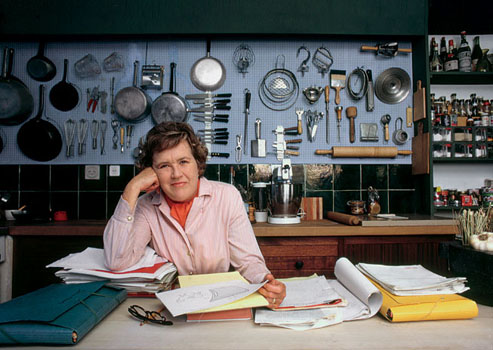
I am reading My Life in France, the autobiography of Julia Child, who was a very remarkable woman. Despite being vaguely aware of her as a prominent influential force in shaping serious cooking in America, I had never really paid much attention to her even when I started studying cookery myself. But when I heard that her autobiography was interesting and charmingly written, full of musings on food and cooking, I thought it might be good to pick up. It turned out to be a great read, chronicling her journey, undertaken unusually late in life, from unserious socialite with no strong direction in life to discovering a passion for the French style of cooking so great that she ended up writing the definitive encyclopedia on bringing that French cuisine to the American kitchen.
She is a remarkably modern-sounding person, despite having chronicled herself so many decades past. She and her husband are adorable, utterly in love and totally supportive of one another's efforts; she moved all around the world for the sake of her husband Paul's work, and he was there helping her every step of the way as her fame and career took off. What I think makes her most special is that she brought real French cuisine to the American public; she was the first person to suggest to average Americans that if they were willing to put in a little effort they could produce dishes from scratch that had that real French character and quality to them. Before her, people did not really think they could learn to cook like that, that it was some mysterious alchemy that only French chefs could enact. In fact, as she was writing her most famous work, Mastering the Art of French Cooking, her publishers at first said no housewife would be interested in learning so much or in doing anything so difficult. What they didn't see was that there are people for whom cooking is more than just the cheapest way to get a dinner in your belly, but Julia gave them what they needed to elevate their cooking to art.
After finishing her autobiography I then found it necessary to examine her seminal work, Mastering the Art of French Cooking, which is not so much a recipe book as a reference text for the techniques and theories of French cuisine. I can see why people took to it the way they did, especially those who wanted to really do it right. She explains French kitchen process remarkably well, from how they select their produce to how they pair their meals with wine to a most excellent breakdown of the interrelation of the classic sauces. That section is particularly good, explaining the mechanics of each mother sauce before carrying on into descriptions of the most important small sauces that can be made from them.
As you may know, I am really interested in the process of the artist, how they came to put their work together. I believe by understanding process we can improve our product. So it was particularly interesting to me to see Julia's process of putting the cookbook together-- breaking down French cuisine to the essential principals a chef must understand, deciding which recipes best exemplified those principals and the flavor profiles she wanted to represent, and then the steps of recipe design, painstakingly writing out each recipe then an endless series of testing and retesting for reproducibility in the home kitchen. It was this rigorous process that allowed her to deliver the remarkably high quality product she did, that has been so useful and instructive to so many generations of cooks.
My mom is giving me her copy of the book to take back with me. I will probably not make many of the recipes from it. Even putting kosher concerns aside, I don't want to introduce that much cream, butter, and starch into my diet. Only on special occasions, perhaps. But I will be glad to have it for reference for when I am trying to understand the building blocks of outing together great dishes, which is the real trick to becoming a great cook.

I am reading My Life in France, the autobiography of Julia Child, who was a very remarkable woman. Despite being vaguely aware of her as a prominent influential force in shaping serious cooking in America, I had never really paid much attention to her even when I started studying cookery myself. But when I heard that her autobiography was interesting and charmingly written, full of musings on food and cooking, I thought it might be good to pick up. It turned out to be a great read, chronicling her journey, undertaken unusually late in life, from unserious socialite with no strong direction in life to discovering a passion for the French style of cooking so great that she ended up writing the definitive encyclopedia on bringing that French cuisine to the American kitchen.
She is a remarkably modern-sounding person, despite having chronicled herself so many decades past. She and her husband are adorable, utterly in love and totally supportive of one another's efforts; she moved all around the world for the sake of her husband Paul's work, and he was there helping her every step of the way as her fame and career took off. What I think makes her most special is that she brought real French cuisine to the American public; she was the first person to suggest to average Americans that if they were willing to put in a little effort they could produce dishes from scratch that had that real French character and quality to them. Before her, people did not really think they could learn to cook like that, that it was some mysterious alchemy that only French chefs could enact. In fact, as she was writing her most famous work, Mastering the Art of French Cooking, her publishers at first said no housewife would be interested in learning so much or in doing anything so difficult. What they didn't see was that there are people for whom cooking is more than just the cheapest way to get a dinner in your belly, but Julia gave them what they needed to elevate their cooking to art.
After finishing her autobiography I then found it necessary to examine her seminal work, Mastering the Art of French Cooking, which is not so much a recipe book as a reference text for the techniques and theories of French cuisine. I can see why people took to it the way they did, especially those who wanted to really do it right. She explains French kitchen process remarkably well, from how they select their produce to how they pair their meals with wine to a most excellent breakdown of the interrelation of the classic sauces. That section is particularly good, explaining the mechanics of each mother sauce before carrying on into descriptions of the most important small sauces that can be made from them.
As you may know, I am really interested in the process of the artist, how they came to put their work together. I believe by understanding process we can improve our product. So it was particularly interesting to me to see Julia's process of putting the cookbook together-- breaking down French cuisine to the essential principals a chef must understand, deciding which recipes best exemplified those principals and the flavor profiles she wanted to represent, and then the steps of recipe design, painstakingly writing out each recipe then an endless series of testing and retesting for reproducibility in the home kitchen. It was this rigorous process that allowed her to deliver the remarkably high quality product she did, that has been so useful and instructive to so many generations of cooks.
My mom is giving me her copy of the book to take back with me. I will probably not make many of the recipes from it. Even putting kosher concerns aside, I don't want to introduce that much cream, butter, and starch into my diet. Only on special occasions, perhaps. But I will be glad to have it for reference for when I am trying to understand the building blocks of outing together great dishes, which is the real trick to becoming a great cook.
Saturday, December 25, 2010
Boy goats

Tuesday, December 21, 2010
Lewis Shapes Me Still

Back in those days, before I tried to examine the appeal, I knew only that the stories felt so right to me. It was as if Lewis plugged the brain of someone else directly into mine, and all the visceral feelings that could not be described poured through me as if the book’s experiences were my own. He had an uncanny way of capturing so much of what was so important to an imaginative, idealistic child— wanting to do the right thing even if you don’t know what the right thing is, the guilt you feel when you act small and petty because you’re hurting and exhausted, and the true nature of bravery that isn’t so much about being unafraid as it is pressing on despite your fear. The way I felt through all of those things, all the good things I wanted to be and do, and all the bad things I hoped someone would forgive, Lewis seemed to understand, and so capably put into words.
As I ventured into writing myself, more than anything else I’d ever read I wanted to emulate this ability of Lewis’s— that of conveying how people really felt. Observing the way he did it, I endeavored to learn how to take all the unvoiced gut feelings of my internal self and translate them into words. As I grew, I wondered if there was anything else that could speak to me in the way Narnia did, more to feed the fires of my growing desire for writer’s knowledge. When I learned how much else Lewis had written, I had to read more.
In the Chronicles of Narnia, Lewis used the phrase “for the first time” as an expression of the experience of the numinous. To this day, I cannot hear the phrase without the same associations. In reading more and more of Lewis’s work, I discovered many new things that gave meaning to that phrase for me. Through him, “for the first time,” I met many things that were numinous to me. I read his other fantastical fiction, the Space Trilogy and Till We Have Faces. I read his satire, The Screwtape Letters and The Great Divorce. I read his Christian apology, Mere Christianity, The Problem of Pain, and Miracles. I read Surprised by Joy and A Grief Observed, his autobiographical works. Though I loved some better than others, every one of them touched me in a unique way, and each one taught me more about how the written word can touch you.
His Christian apology helped me with the questions in my own soul. I am a religious Catholic, but for me it manifests very much internally— a system of belief and values that informs the way I live more than something I often display obviously. I cannot usually connect with religiosity that is expressed more in form than in philosophy. But here was Lewis, for whom faith was not a collection of dos and don’ts, nor empty rituals, nor a lot of pedagogical Bible stories. As was the Deeper Magic from The Lion, the Witch, and the Wardrobe, it was simply the truth of the universe, inbuilt within the bones of the world. It needed to be examined and understood as much as chemistry and physics. Even when I did not agree with his point of view, the method by which he worked it out always made sense to me. For the first time, I had a framework with which to examine and codify my own beliefs.
Though his autobiographical works, I learned more about the life he’d led and the kind of man he was. His existence had often been a hard one— a lonely, difficult childhood, endless family tragedy, and a fraught struggle to come to peace with the nature of God. It was interesting to contrast his person with that of J.R.R. Tolkien, a contemporary of his and another author I’d grown up on. Tolkien was so certain of himself, of his identity and of the things he believed, and had been all his life. Lewis, by contrast, had none of the comfort of easy truths. Every truth he’d ever come to he had suffered dearly for, deconstructing, tearing his own guts apart so that he could examine every hidden piece. And for the first time I saw from where his grasp of humanity came. He knew himself at all costs, from the totality of his strengths to the depths of his weaknesses, that knowledge coming to him only by the stark, merciless self-judgment he enforced on his struggle to attain it. And from his self-knowledge came knowledge of man, by the same uncompromising process. He was so ruthlessly fair, clear-eyed enough to regard the complicated nature of humanity with just the right measure of judgment and compassion. He articulated both “Who am I, that it is so wrong that I should suffer?” and “I am such that my suffering does signify.” He was so full of that burning contradiction, so strange and yet so critical, of the everything and the nothing of our state, unafraid to at once accept the burden and claim the significance.
In seeing his own weakness, he learned what human weakness was. In seeing his own strength, he grasped the nature of human strength. He kept cutting, no matter how painful, until he exposed truth. And when he wrote, he had all the glory of that knowledge giving fire to everything he said.
And, for the first time, I understood. His work hit me in the gut because his work encompassed the truth of mankind. This was it, I realized. This was why I loved his writing above all others. There were points of style, of course. I always have admired the way he manages to cap his paragraphs with the punchiest, most spot-on sentences that just perfectly conclude the point. But by and large his writing is unadorned, without flourish. He is not a writer of poetical device. He tells you exactly, straightforwardly, what he means to tell you. And in that, his plainspoken words were given gravitas and elegance by the perfection with which he reflected the human condition. That was the power, that was the beauty of all of Lewis’s varied work. His understanding of the human soul felt more real to me than that of any writer I’d ever read. I felt its realness in my bones, and my own view grew and changed through its influence.
That, I believe, is the key— to communicate the truth of such ethereal things, you must do the hard work of coming to grips with them. Perhaps no one can teach understanding of the self, or of humanity. But Lewis taught me how to go about seeking them. And the more I develop it, the more real, the more true, and the more powerful my work will become. By pouring it into my writing, perhaps my work will be able to touch others the way Lewis’s work touched me.
More than any other author, Lewis has shaped the writer, the Christian, and the person I am. Someday I hope I will write with the same significance, the same power to move as his did, and encourage someone else to try and capture their truth.
Monday, August 30, 2010
Lovely weekend with Jared
Goodness me, wonderful weekend! Jared and I have been making the most of his visit, running around seeing friends and doing things. Saturday was mostly spent trying to hang out with people. We had a great lunch with a bunch of our undergrad friends in Usdan during the day, and a dinner with a different group at night. God, I wanted to invite everyone I knew to this dinner so they could hang with Jared, but sadly it's tough to host more than ten at a time at Elsinore. This is a primary reason I am endeavoring to have a rotating guest list. But being limited to ten was a real shame, especially because of how fantastic the dinner was.
Last week sometime, you see, I was struck with an idea of culinary genius. I would make a meal consisting entirely of different toppings for crostini. I would toast a big old basket of bread, and make three different kinds of spread to eat on top of it in whatever combination the guests pleased. I roasted eggplants for eggplant caviar with carmelized onion and toasted walnuts, I chopped up tomatoes, basil, and mozzarella cheese for a caprese, and sauteed mushrooms, leeks, and shallots in marsala wine for duxelles. I was particularly proud of the last one, because I changed the recipe I was using to include the marsala reduction, which I think improved it vastly, as well as pureeing it at the end. It's only recently that I've felt confident enough in my culinary knowledge to alter recipes, so I'm really pleased. Also, I tried a slightly experimental service option. I gathered up my rather large collection of ramekins (recently joined in the cabinet by a couple brought my Charlotte) and divided the various toppings between them, and had them placed one each of them at various intervals across the table. This made it so all the guests had easy access to a small amount of each spread, and everyone had knives and spoons with which to spread the deliciousness. The lovely guests brought amazing spreads as well-- garden-fresh-tomato puttanesca and roasted garlic and white bean from captainecchi* and electric_d_monk*, hummus from morethings5*, tapenade from in_water_writ*, and sweet potato-carrot from lightgamer*, all unique, all delicious. I am going to give this experimental dinner style a big thumbs up, and I will certainly be doing it again soon.
Sunday Jared and I went with April to acousticshadow2*'s new larp, Nepenthe a Surcease of Sorrow. It ran at WPI, and EB lent me a wedding dress for my costume. I painted my face with white greasepaint and wandered around with the air of a broken little girl whose sanity has gone just a little over the edge. The larp reminded me in many ways of Alice, a gothic game with strong literary roots-- as a big Poe fan, I was pleased by many of the references --but a lot of the darkness in it was kind of over-the-top, which gave the game much more of a "pulp" and "melodrama" feel as opposed to that of "tragedy." Given the connection with Poe, tonally that is fitting. We all had fun, and I encouraged EB to bid it for Festival this year.
Jared will be leaving this afternoon, leaving Boston and leaving me bereft. I am always so sorry to see the end of his visits, but as always I must just look forward to the next one. It's been wonderful having him here again, so I will try to let that carry my spirits.
Last week sometime, you see, I was struck with an idea of culinary genius. I would make a meal consisting entirely of different toppings for crostini. I would toast a big old basket of bread, and make three different kinds of spread to eat on top of it in whatever combination the guests pleased. I roasted eggplants for eggplant caviar with carmelized onion and toasted walnuts, I chopped up tomatoes, basil, and mozzarella cheese for a caprese, and sauteed mushrooms, leeks, and shallots in marsala wine for duxelles. I was particularly proud of the last one, because I changed the recipe I was using to include the marsala reduction, which I think improved it vastly, as well as pureeing it at the end. It's only recently that I've felt confident enough in my culinary knowledge to alter recipes, so I'm really pleased. Also, I tried a slightly experimental service option. I gathered up my rather large collection of ramekins (recently joined in the cabinet by a couple brought my Charlotte) and divided the various toppings between them, and had them placed one each of them at various intervals across the table. This made it so all the guests had easy access to a small amount of each spread, and everyone had knives and spoons with which to spread the deliciousness. The lovely guests brought amazing spreads as well-- garden-fresh-tomato puttanesca and roasted garlic and white bean from captainecchi* and electric_d_monk*, hummus from morethings5*, tapenade from in_water_writ*, and sweet potato-carrot from lightgamer*, all unique, all delicious. I am going to give this experimental dinner style a big thumbs up, and I will certainly be doing it again soon.
Sunday Jared and I went with April to acousticshadow2*'s new larp, Nepenthe a Surcease of Sorrow. It ran at WPI, and EB lent me a wedding dress for my costume. I painted my face with white greasepaint and wandered around with the air of a broken little girl whose sanity has gone just a little over the edge. The larp reminded me in many ways of Alice, a gothic game with strong literary roots-- as a big Poe fan, I was pleased by many of the references --but a lot of the darkness in it was kind of over-the-top, which gave the game much more of a "pulp" and "melodrama" feel as opposed to that of "tragedy." Given the connection with Poe, tonally that is fitting. We all had fun, and I encouraged EB to bid it for Festival this year.
Jared will be leaving this afternoon, leaving Boston and leaving me bereft. I am always so sorry to see the end of his visits, but as always I must just look forward to the next one. It's been wonderful having him here again, so I will try to let that carry my spirits.
Friday, August 20, 2010
Alton Brown's Gear for Your Kitchen
Borrowed "Alton Brown's Gear for Your Kitchen," from a coworker and am thus far finding it an engaging and informative read. I always have liked his philosophy of optimizing for quality and multi-utility so that you focus on buying as few items as possible to get the only pieces that do the best and most varied jobs. I very much approve of his ban on unitaskers. I've been curious about this book because if I have one criticism with the way gear is presented on the show is with the assumption that you want your kitchen prepared for every possible cooking eventuality and plan to stock accordingly. But of course the home cook is obviously not going to be making everything, at least not on a regular basis, due to individual tastes. I certainly don't fault the show for this-- they can't possibly know what every viewer is interested in and there's no other way to present such a wide variety of dishes, techniques, and ingredients --but I was curious how the book would approach that problem. Say, for example, I am much more of a cook than a baker-- what pieces of bakeware are useful for me? Or maybe, I don't plan on making a certain kind of dish enough to warrant certain special pieces, is there something less optimal but more versatile that I can sub in instead?
I am pleased to find that the book does attempt to reconcile optimization with necessity. He will say what the best of everything is, but he also acknowledged when you only need an item for very specific things, or what the absolute kitchen necessities are if you only plan on acquiring a few things. He also details all the important features of your various tools, such as the qualities of various materials. His chapter on pots and pans is awesome, and the one about knives is particularly excellent. He also recommends tracking how frequently you use each of the tools you already have and how well they work, in order to determine what is important to you, what is useless to you, and what is insufficient for its task. This lets you figure out what to keep, what to get rid of, and what to replace. I would love to run such a trial myself. All in all, the book is a more detailed, more intensive version of the sort of information they present on the TV show, but, as I hoped, with more of a mind to how you figure out what you really need in your own personal kitchen.
I am pleased to find that the book does attempt to reconcile optimization with necessity. He will say what the best of everything is, but he also acknowledged when you only need an item for very specific things, or what the absolute kitchen necessities are if you only plan on acquiring a few things. He also details all the important features of your various tools, such as the qualities of various materials. His chapter on pots and pans is awesome, and the one about knives is particularly excellent. He also recommends tracking how frequently you use each of the tools you already have and how well they work, in order to determine what is important to you, what is useless to you, and what is insufficient for its task. This lets you figure out what to keep, what to get rid of, and what to replace. I would love to run such a trial myself. All in all, the book is a more detailed, more intensive version of the sort of information they present on the TV show, but, as I hoped, with more of a mind to how you figure out what you really need in your own personal kitchen.
Thursday, August 5, 2010
Stuff to work on
Since I'm feeling pretty good right now, I am settling my brain onto the various things I feel like I should work on in the near future.
I think it's time to get serious about looking for a different job. The one I've got now is perfectly pleasant and all, and they've been very nice to me here, but it's not really what I want to be doing and while the pay isn't bad, they don't give me as many hours as would take some of the pressure off the old budget. So I think it's time to try and find something more to my interest that pays a little better. I know it's a tough market out there, but I have recently just reached one full solid year of real work experience, and I know that it's usually easier to find a job once you have one and prove you could hold it down. So I'm a little hopeful. Ideally I'd like something in writing, editing, or publishing, so that's where I'm concentrating my search. I am not relishing the whole searching and applying process, but I've gotten a few applications out there and I am resolved to buckle down on this.
I really need to get writing again. It's been a while since I really did serious writing-- there was The Labor Wars, but that is finished now and I should keep myself busy. I certainly need to get cracking on my Intercon K bid, The Stand. I've actually made some progress on it recently that I'm very pleased with, but I don't want to lose momentum. Also, I should really work on some non-gaming stuff, something that I could actually maybe possibly someday take to a publisher and take a shot at the the hopeless pipe dream I'd really like to go after, being a professional writer. I have a lot of stuff started that has languished due to being busy with life, school, work, gaming, and stress, and a lot of it really wasn't half-bad. I am resolved to work on The Stand as well as a piece of literature that maybe I could someday get published.
Also, I want to continue the progress I've made on actually taking care of my health. I am not working out every day like I wanted to, but I am working out more frequently now than I was before. I have not been perfect about my skin care routine, but my acne is greatly reduced and my face looks clearer than it has in ages. I've also been drinking a lot more water. Since Jared's parents gave me this really nice metal water bottle, I've been carrying it around and actually drinking from it. The only downside is my body is still accustomed to being chronically on the edge of dehydration that it doesn't know what to do with all the extra water, and so I'm sent running to the bathroom every fifteen minutes. My eating habits are mostly okay, though this past week or so they were all thrown to hell. I'll have to get back on track with that. I've also decided that I'm going to have at least one day a week where I don't eat or buy any meat. This is more for environmental and pocketbook reasons than health, but I think it's a good small change to make.
The last thing is, I've been something of a recluse lately. My being extremely busy (between work, chores, and rehearsal, my life was gone) and feeling a bit low has kept me from doing much of anything with friends. I mean to rectify this. In the weeks to come, I want to have social events and do fun things with friends again. I know I certainly didn't have nearly as many dinner parties as I meant to this summer. Please don't think I have forgotten you all, it's just my way to withdraw when the stress mounts. But if I'm managing it better and working on improving the situations that cause it in other parts of my life, I should be able to get back to my old self again.
With all the stress I've felt lately, I think having some positive efforts to focus on will help me keep steady and eventually improve. The change will do me good.
I think it's time to get serious about looking for a different job. The one I've got now is perfectly pleasant and all, and they've been very nice to me here, but it's not really what I want to be doing and while the pay isn't bad, they don't give me as many hours as would take some of the pressure off the old budget. So I think it's time to try and find something more to my interest that pays a little better. I know it's a tough market out there, but I have recently just reached one full solid year of real work experience, and I know that it's usually easier to find a job once you have one and prove you could hold it down. So I'm a little hopeful. Ideally I'd like something in writing, editing, or publishing, so that's where I'm concentrating my search. I am not relishing the whole searching and applying process, but I've gotten a few applications out there and I am resolved to buckle down on this.
I really need to get writing again. It's been a while since I really did serious writing-- there was The Labor Wars, but that is finished now and I should keep myself busy. I certainly need to get cracking on my Intercon K bid, The Stand. I've actually made some progress on it recently that I'm very pleased with, but I don't want to lose momentum. Also, I should really work on some non-gaming stuff, something that I could actually maybe possibly someday take to a publisher and take a shot at the the hopeless pipe dream I'd really like to go after, being a professional writer. I have a lot of stuff started that has languished due to being busy with life, school, work, gaming, and stress, and a lot of it really wasn't half-bad. I am resolved to work on The Stand as well as a piece of literature that maybe I could someday get published.
Also, I want to continue the progress I've made on actually taking care of my health. I am not working out every day like I wanted to, but I am working out more frequently now than I was before. I have not been perfect about my skin care routine, but my acne is greatly reduced and my face looks clearer than it has in ages. I've also been drinking a lot more water. Since Jared's parents gave me this really nice metal water bottle, I've been carrying it around and actually drinking from it. The only downside is my body is still accustomed to being chronically on the edge of dehydration that it doesn't know what to do with all the extra water, and so I'm sent running to the bathroom every fifteen minutes. My eating habits are mostly okay, though this past week or so they were all thrown to hell. I'll have to get back on track with that. I've also decided that I'm going to have at least one day a week where I don't eat or buy any meat. This is more for environmental and pocketbook reasons than health, but I think it's a good small change to make.
The last thing is, I've been something of a recluse lately. My being extremely busy (between work, chores, and rehearsal, my life was gone) and feeling a bit low has kept me from doing much of anything with friends. I mean to rectify this. In the weeks to come, I want to have social events and do fun things with friends again. I know I certainly didn't have nearly as many dinner parties as I meant to this summer. Please don't think I have forgotten you all, it's just my way to withdraw when the stress mounts. But if I'm managing it better and working on improving the situations that cause it in other parts of my life, I should be able to get back to my old self again.
With all the stress I've felt lately, I think having some positive efforts to focus on will help me keep steady and eventually improve. The change will do me good.
Subscribe to:
Posts (Atom)
